Tuesday, March 27, 2012

Southern California Edison lied? Well, I'll be darned!

March 27, 2012

Dear Readers,

In my opinion, the most amazing pump in the universe -- the most amazing machine in the universe -- is the main pump inside your chest, the human heart.

When your main pump fails, you're in BIG trouble -- unless it's recognized in time, of course. Then you stand a chance. In 1967 Dr. Christiaan Bernard performed the first human heart transplant, in South Africa. (Dr. Bernard and his team had performed heart transplant operations dozens of times on animals prior to that.) In the 45 years since then, tens of thousands of heart and heart/lung transplants have been performed on people all around the world.

Last week former U.S. Vice President Dick Cheney was the recipient of a "new" heart.

Long live the automobile industry, where most of the "organ donors" in America come from!

Ugh, what's wrong with THAT sentence? I mean besides the obvious: That someone more deserving than Dick Cheney might have deserved that heart? If you can figure it out, perhaps you can understand what's wrong with nuclear power. Yes, it's really that simple! Nuclear power kills. There might be some benefits, but along the way, it kills. There are vastly safer ways to either conserve or generate electricity without increasing global warming. We don't need nukes. Would it be argued that we need car accidents just to be sure we have organ donors?

Vice President Cheney's old heart was no good (what a surprise!): He had quadruple bypass surgery 24 years ago, then two angioplasties, and a heart monitoring device put in (later removed). There wasn't much left to do but replace the thing! He reportedly was on the "waiting list" for a suitable donor organ for the past 20 months.

San Onofre Nuclear (Waste) Generating Station in Southern California is falling apart, and so they keep putting new parts in. Last time, it was new turbine blades (for "greater efficiency" they said) and a new reactor pressure vessel head (because the old one was rotting, decaying, corroding, embrittling, rusting -- you get the idea).

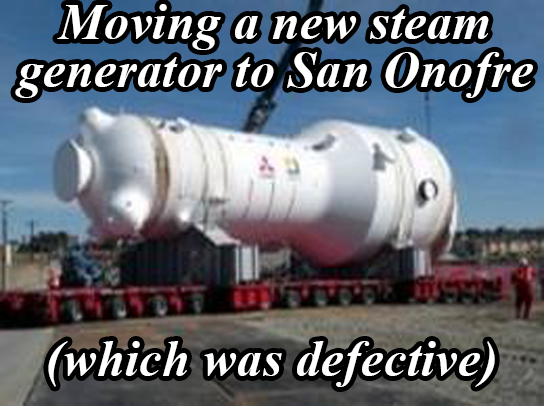
The time before that, a little over a year ago, it was four new steam generators, two per reactor. The time before that it was something else, and something else the time before that. Billions of dollars worth of parts -- but billions more dollars worth of parts are NOT being replaced UNLESS they fail! And the new parts aren't working, anyway.

The ratepayers are paying for everything, of course. It's always the ratepayer who pays, so the utility's investors can make money. The California Public Utilities Commission ensures that electricity rates will be sufficient so that the utility will make money. How much? Enough to keep the utility happy.

But Southern California Edison is not so happy right now, because their #1 cash cow isn't giving any milk. SanO has been completely shut down for nearly two months and isn't likely to reopen any time soon. So the utility is losing about a million dollars a day per reactor. They could get most of the money some other way, because people NEED electricity and they can supply it, or at least help us exchange it with each other. But nuclear reactors, once operating, are relatively cheap to maintain -- as long as the ratepayer covers most extra costs. And as long as someone (John Q. Public) takes the waste away eventually, or at least promises to (the federal government promised to, but hasn't done so). And as long as nothing goes wrong. Then they can be very, very expensive, as they learned in Japan and the Ukraine, and as we hope NOT to learn firsthand here.

Your main pump -- your heart -- can fail in many ways. The muscle of the pump can fail to get the proper bioelectrical signal that tells it to beat. If this potential problem is noticed in time, a pacemaker can be implanted so that an artificially-produced electrical signal can be applied to the heart.

At the Brown's Ferry reactor in Tennessee in 1975, a careless worker using candles to test for air leaks in an operating reactor started a fire that nearly caused a meltdown. The electrical signals to the pumps (and everything else) were lost. The practice of using candles to check for leaks in operating reactors has since been banned (gee... one would have thought...) but additional fire codes, created after the incident, have not been implemented at many reactors around the country -- including San Onofre!

Dick Cheney lied about the agenda and the participants of his secret his pro-nuclear energy policy (and many other things). Likewise, San Onofre's owner/operators lie about just about everything, too. Today (March 27th, 2012) a new report indicates that Southern California Edison misled the Nuclear Regulatory Commission -- and everyone else -- about the new steam generators. SCE said they were designed as exact replacements for the old steam generators. But it appears that in reality, their fluid flows were redesigned to increase output! But apparently instead, the new design increased their own wear and tear!

Your heart beats about once per second for your entire life -- more if you're stressed or exercising. First it contracts the upper two chambers, called the left and right atria. Then while they're still contracted, the lower two chambers, called the ventricles, contract. Then it rests for a while, and refills will blood.

In your heart, there are two valves between the atria and the ventricles, and two more at the egresses from the ventricles. These four valves do a nearly perfect job of preventing backflow. In a sense the heart is two pumps. One side pumps blood to your lungs, the other side pumps blood that comes back from the lungs to everywhere else. The two sides pump in unison. The pressurized flow of blood puts a strain on the valves, the heart, and the blood vessels of the system. As they get older, the blood vessels tend to harden and weaken, and their inner diameters get smaller due to build-up of "plaque" over time, which causes the heart to have to pump harder to get enough blood to wherever it's needed (stomach when you're digesting, brain when you're thinking, muscles when you're exercising, etc.). Higher blood pressure is a strong indicator of an increased risk of a heart attack, and does extra damage to the blood vessels. You want to keep your pipes pliable! Keep your cholesterol low, because it is a good indicator of how quickly plaque is building up in your system.

The new steam generators at San Onofre are -- like the rest of the plant -- falling apart. They are the direct cause of the reactors being completely shut down for the longest period in the plant's history, with no end in sight.

Steam generators transfer the heat of the nuclear reactor from the primary coolant loop to the secondary loop. The secondary loop turns to steam, but the primary loop is kept under enormous pressure so that it does NOT turn to steam -- 2200 PSI (atmospheric pressure is under about 15 PSI).

San Onofre's steam generator tubes have become prematurely weakened and have started to fail. One tube ruptured during operation, causing that reactor to be shut down, and seven more tubes failed during subsequent pressure testing. Premature wear was found on hundreds of additional tubes in the other reactor.

If only one tube ruptures, as happened last January, it can send fragments of metal through the system, which could block valves or fluid flow around the reactor core, causing a cascade of further problems. One rupture could even cause neighboring tubes to rupture in a cascade of tube failures. This could lead to a catastrophic meltdown of the reactor!

If any of the four valves in your heart starts to fail, they can usually be replaced with "mechanical" heart valves (usually ball valves) or "biological" (tri-flapper valves) almost exactly like the originals, taken from pig hearts. In any case, they are known as "artificial" heart valves.

Artificial heart valves sometimes fail due to a phenomena known as "cavitation" (see below). The valve that takes the most flow and the highest pressure -- the mitral valve (between the left atrium and the left ventricle) -- is also the one that is most prone to failure due to cavitation problems.

Cavitation could certainly be the cause of San Onofre's problems right now -- or it could be "plaque" (scale) buildup on the steam generator tube's walls. Perhaps the problems were caused by radiation from the "scale" buildup or from other radioactive materials in the primary coolant loop. Or it could be manufacturing defects, or even damage during shipping which was overlooked during inspection when the steam generators arrived at the plant (we were told they were thoroughly inspected). Perhaps they were damaged during installation, or any number of other things. Bad filtration of the primary or secondary coolant could leave all sorts of crud swirling around in the system that shouldn't be there. Perhaps SCE was trying to increase the operating pressure and/or temperature, so they could spin the turbine faster and make more money? That's what some people are suggesting, but since the investigation is closed to the public, we can only guess.

The utility is already "warning" us that summer blackouts are possible a few months from now. But instead of doing something realistic about it, they want us to pay for them to replace the steam generators AGAIN (and thousands of other worn-out parts) with any replacements they can find -- even if they work at a reduced capacity -- and then replace them AGAIN after they've redesigned them and -- this time -- gotten the proper federal approvals -- perhaps by simply going back to the original design (if they can find the blueprints)!

Hey, fellow ratepayers: Got deep pockets? We're going to need them! All this work will almost surely be done entirely at the ratepayer's expense. And Southern California Edison will say they need to do it in order to keep our lights on. But it's really to make money for themselves at the risk of Fukushima USA here.

The fact is, Southern California Edison has plenty of time to get ready for summer's increased energy load, AND for no longer having San Onofre ever again.

One small thing they should do immediately is begin an emergency program to install hundreds of thousands of devices to prevent people from using washing machines, dish washers, dryers and air conditioners during a power shortage. SCE has already installed thousands of these devices over the years, but they could redouble or triple that effort. It would make a significant difference during peak demand periods!

Another thing SCE could do is get the extra transmission lines installed that they claim they'll need. But hey! That sounds fishy because there's supposed to be more than enough power lines coming IN to Southern California so that San Onofre won't melt down from an extended "station blackout" even during peak summer energy use periods! (It was a prolonged station blackout that made the meltdowns in Fukushima inevitable.)

Southern California Edison could be building offshore wind turbines instead of hiring more gasbags to tell the public that we need San Onofre. We don't! Nuclear power is an utterly failed technology. It was originally pushed on an unsuspecting public which was told that the "fission products" from splitting the atom could and would be properly contained forever -- a pipe dream at the time it was claimed, which has been proven utterly false.

It was pushed on an unsuspecting public with claims that nuclear power would be "Too Cheap To Meter," and that these were "Atoms for Peace." And we were told about a theory called "Hormesis" -- the idea (still believed by those in the nuclear industry but denied throughout the rest of the scientific community) that a little bit more radiation, randomly administered any old way, is good for you, no matter how old you are, no matter how much radiation you've already absorbed in your life, and no matter how much you will absorb in the future.

In reality there is no safe dose, as admitted by numerous government agencies! And yet the nuclear "health physics professionals" and everyone else in the nuclear industry will STILL tell you a little radiation is GOOD for you, so why worry about a big accident as long as it's diluted??? It's poppycock.

Thanks to Fukushima and Chernobyl, and so many times before, tons of plutonium, uranium, and other dangerous radioactive elements have been scattered by the winds, the sea, and the blowing dust, to people all around the globe (people who never benefited from ANY reactor's electricity). In a closed system like earth, people everywhere will inevitably suffer and die for generations to come.

We don't want SanO to be the cause of another nuclear tragedy, and we don't need it to happen: Keep San Onofre shut down. Don't restart it. Don't restart ANY reactor -- shut them ALL down!

Fukushima was a wake-up call to those living within 50 miles -- or a thousand miles -- of any of the ~450 operating nuclear power plants around the world. The nuclear industry wants to keep making money, to keep going as if Fukushima never happened. Their apologists, the health physicists, continue to insist that indeed, nothing DID happen in Fukushima -- or Chernobyl, for that matter. Thousands have already died from Chernobyl, and thousands will die from Fukushima, but their deaths are scattered in time and all over the planet, and so the "health physicists" ignore those deaths, denying any connection to any nuclear accident. But realistic data by highly qualified scientists, in study after study, points to an enormous problem: Nuclear power kills. SanO is shut. Let's keep it that way.

But unfortunately, San Onofre's operators, Southern California Edison, would LOVE to get a completely new reactor instead! And our governor might even help them do it!

Completely new reactors are forbidden by state law here in California until there is a solution to the problem of nuclear waste (which probably means never). Governor Jerry Brown, once on the protest lines against Diablo Canyon, now is so scared of global warming (and so beholden to the energy companies who financially supported his re-election) that he says he would LIKE to see new nukes in California -- as long as someone else will pay for them, of course. Meanwhile, the ones we have are (naturally...) falling apart.

Billions of dollars have been wasted trying to keep them running against all rhyme or reason. Now the ratepayers are being asked to spend billions more. No way!

Nukes? No thanks!

Sincerely,

Ace Hoffman, Carlsbad, California USA (images added 2025)

The author, an award-winning educational software developer, is the co-author of an educational computer program about the human heart called The Heart: The Engine of Life, as well as an educational program about mechanical pumps called All About Pumps. He has also animated hundreds of industrial processes, including nuclear reactors and many of their parts. His book on nuclear issues, The Code Killers, is available for free download from his personal home page: www.acehoffman.org .


John Massey, San Clemente, CA, on cavitation:

"The bubble comes from high liquid velocities that cause the pressure to be reduced to the point where it is below the vapor pressure of the liquid and the liquid changes state to a vapor, hence the bubble. The bubble is a low pressure cavity that will collapse downstream when it is exposed again to the high pressure liquid. When it collapses it causes erosion of the inside of the pipe, noise (water hammer), vibration and sometimes explosive damage to the closed conduit."


Friends of the Earth report by Fairewinds Associates:
http://fairewinds.com/content/foe-report-steam-generator-failures-san-onofre
Late breaking news:

>>Federal agency bars Edison from restarting San Onofre plant
>>
>>Los Angeles Times | March 27, 2012 | 2:52 p.m.
>>
>>The U.S. Nuclear Regulatory Commission, citing serious concerns about equipment failures at the San Onofre nuclear plant, on Tuesday barred plant operator Southern California Edison from restarting the plant until the problems are thoroughly understood and fixed.


EIGHT SIMPLE RULES for protecting your heart:

1) Exercise hard and often.
2) Watch your diet and weight.
3) Avoid tobacco smoke and other pollutants.
4) Control your blood pressure.
5) Minimize stress and enjoy life.
6) Know the warning signs of a heart attack.
7) Get regular medical checkups.
8) Know where the nearest cardiac care facility or hospital is located.


Ace Hoffman
Carlsbad, California USA
Author, The Code Killers:
An Expose of the Nuclear Industry
Free download: acehoffman.org
Blog: acehoffman.blogspot.com
YouTube: youtube.com/user/AceHoffman
Email: ace [at] acehoffman.org
Founder & Owner, The Animated Software Company


Sunday, March 18, 2012

It's definitely time to decommission San Onofre!

Dear Readers,

It's time to decommission San Onofre Nuclear Generating Station. It's the only sensible thing to do. It makes economic sense for just about everybody, and spares us the possibility of "Fukushima USA" here in SoCal.

Right now, neither of San Onofre's two reactors are operating. Southern California Edison is already predicting there could be rolling blackouts during the summer if they can't get the reactors running by then. The threat of blackouts is at odds with the historic record of energy usage, which clearly shows that there is more than enough electrical generating capacity and transmission line capacity in SoCal to replace San Onofre.

Nevertheless, SoCal residents can EXPECT rolling blackouts -- because SCE wants them to happen: It may cost as much as a billion dollars (or more) to repair San Onofre. Instead SCE could be securing contracts NOW for summer energy use. They could be building a billion dollars' worth of solar rooftops, offshore wind turbines, turbine peaker plants, cogeneration plants, energy storage reservoirs, geothermal energy systems, etc..

But they don't want to, because when San Onofre is operating, it's "easy money": A million dollars per day per reactor! So instead they'll want to "prove" that SoCal "needs" San Onofre, so they won't prepare, the blackouts will happen, and then they'll expect us, the ratepayers, to pay for it all!

Meanwhile, there is still NO solution to the problem of long-term storage of nuclear waste, which has been piling up for decades in dangerous "temporary" locations at every nuclear power plant in the country (and nor will there ever be a good solution). And NOR is there a solution to the dangers of nuclear weapons proliferation, which SanO exacerbates by producing plutonium and tritium. Additionally, the dangers from terrorism, or from mother nature's fury, remain unsolved too. San Onofre is built on or near several fault lines, and along the coast, nearly at sea level. It's tsunami-prone and earthquake-prone. And surrounded by about eight million people within 50 miles (noting that the U.S. Government recommended U.S. citizens evacuate from within 50 miles of Fukushima, Japan -- and ALSO noting that even that might not be far enough!).

Furthermore, San Onofre continues to have problems with worker harassment (intimidation of workers to prevent them from reporting dangers) AND, paradoxically, worker safety complaints (that safe procedures aren't being followed). San Onofre is officially (Nuclear Regulatory Commission's own data) the worst-run commercial nuclear facility in the nation on BOTH counts.

A meltdown at San Onofre would be the ruination of SoCal. And we don't need a tsunami or "the big one" to cause it: It's not inconceivable that a thing as simple as a flashlight dropped in the reactor water could start a cascade of failures, leading to a meltdown "just like" Chernobyl or Fukushima. That's why they have regulations to prevent things like dropped flashlights (I mention this specifically because it happened there last month, and the contract worker, a temporary employee at the plant, who violated workplace rules by dropping the flashlight, then further violated the rules by trying to retrieve it -- and falling in!)

SCE doesn't want to be responsible for ANY of the costs to fix the reactors. They just want to fix them any way they can, so they can restart them as soon as possible, so they can go back to making money -- and creating a ton a week of highly dangerous "spent fuel" which will be the real legacy of San Onofre's decades of operation: Millions of pounds of deadly poison sitting on our shoreline just waiting to be released by accident/sabotage, etc.. Southern California Edison will be long out of business, all of us will be long dead, California will be a nation unto itself (perhaps), but the waste will still be here.

The cause of San Onofre's current shutdown is defective replacement Steam Generators (SGs) made in Japan by Mitsubishi Heavy Industries. MHI has been building SGs for nuclear power plants since the 1970s and have manufactured, shipped and installed well over 100 SG units around the world. MHI's current annual report indicates they plan to double their nuclear steam generator business several times in the next three years to almost $10 billion annually. So this is a big setback for them as well as for SanO's owners. The problem is almost surely the result of incorrect manufacturing procedures: This didn't have to happen. What other SGs around the world are in trouble?

Steam Generators are massive things used in Pressurized Water Reactors (PWRs). PWRs have three coolant loops: Water under very high pressure in the primary loop goes through the reactor core, gets heated (and irradiated), and then goes through thousands of very thin tubes inside the steam generators.

San Onofre's two SGs each have nearly 9,500 long, thin U-shaped tubes (the tube's walls are about the thickness of a credit card). Because the water inside the thin tubes is highly pressurized, it does not boil. The water on the other side of the tubes (the secondary coolant loop) comes in contact with the hot tubes and turns to steam. The steam is piped out of the containment domes and into the turbine room, where it is used to turn the turbines which generate electricity. A third coolant loop (ocean water) condenses the steam in the second loop, and that condensate is then pumped back into the steam generators again.

When any company receives $800 million worth of equipment, it invariably inspects that new equipment very carefully to make sure it's exactly what they ordered. San Onofre's replacement steam generators were inspected when they arrived at the plant in 2009, and found to be defective. MHI had to send out a special team to SoCal to reweld them. Like the defects that are appearing now, those defects SHOULD NEVER HAVE MADE IT OFF THE FACTORY FLOOR.

You can be sure numerous additional inspections were done after the problems were discovered in 2009. The additional inspections and repairs took about six months. Then they put the steam generators in the reactors (two SGs in each of two reactors) and just over a year later... problems, problems, problems!

The first problems to show up were in Unit II, the older of the two operating reactors and the one to get its steam generators replaced first. Excessive wear was discovered on the thin U-shaped tubes inside the SGs, when were inspected during Unit II's first refueling outage after the SG replacement. The outage was already far from "routine" despite repeated assurances by the utility that it was "just" a routine refueling outage: The Reactor Pressure Vessel Head was being replaced, which is another massive (and expensive!) part which had worn out prematurely. Neither the RPVH nor the SGs were ever supposed to wear out in the entire life of the plant.

Unit II's SG wear is significant: Two tubes had at least 30% wear, and nearly 70 tubes had at least 20% wear, and about 700 tubes had at least 10% wear. The new SGs are expected to last 40 years or longer -- but all of this excessive wear was detected after only about 14 months of operation! PWRs rely on the SGs to remove excess heat from the reactor. They are a vital safety component of the reactor, which is one reason there is a minimum of two SGs per reactor (sometimes more than two) in every PWR in the world -- in case one fails.

San Onofre's engineers were quick to explain to the media and the public that the wear they found on Unit II was probably just wear from "settling in": The parts merely had to "get comfortable" with each other. I actually heard SanO employees using these "engineering" terms!

Then Unit III's steam generators failed, too -- and it was "discovered" the hard way: A rupture. One of the nearly 20,000 tubes inside Unit III's SGs suddenly burst, and the subsequent release of primary coolant -- which is highly radioactive -- into the secondary coolant loop -- which normally isn't very radioactive -- caused the control room operators to have to shut down that reactor as well. Some radiation was released to the atmosphere (and to the public) when the radioactive steam condensed back to water at atmospheric pressure.

Calling what happened Last January merely a "leak" is being too nice: It was an extremely violent flashing to steam of super-heated, super-pressurized radioactive water and chemicals. (If you passed your arm accidentally over the breach, it would take your arm off (by steaming it off!) in an instant. (But at least the stump would be sanitized.))

Such steam generator tube ruptures are rare, and it's a good thing: The real danger would be that one burst tube would damage the tube next to it, which would burst too, and so on in a cascade of failures that would throw metal parts throughout the primary and secondary coolant loops, damaging valves and reactor fuel assemblies, blocking water flow, and damaging the other SG. And then what? Fukushima USA: An inability to cool the reactor -- a meltdown.

San Onofre avoided that, but their troubles had only just begun.

After letting the reactor cool for several days, technicians went in and started trying to discover what had gone wrong with Unit III's new steam generators. Was it "just" wear, like Unit II was experiencing? It doesn't appear to be the same problem: SanO employees identified 129 tubes that appeared to be excessively worn, and started pressure-testing them. This involves increasing the pressure in one tube at a time to about three times the normal operating pressure. Seven tubes have failed these tests already, and they've only just begun that phase of the testing!

Will it ever be safe, or reasonable, to restart these reactors with Mitsubishi Heavy Industry's steam generators? When BOTH units are having problems? (Exactly ONE tube in Unit II was pressure tested in light of the problems with Unit III. That one tube passed the test. All pressure tested tubes are plugged up permanently, and can no longer be used.)

There can be little doubt now that MHI has been delivering products with criminally-negligent workmanship, and San Onofre has been accepting those parts and using them.

One meltdown at SanO -- or two -- would destroy everything we love about SoCal. Why spend billions of dollars just to restart THAT risk? Right now we just have the spent fuel to deal with -- the radioactive waste pile. It's deadly, difficult to manage, and will cost a fortune. But at least it's NOT GROWING at the moment, and that's good. In fact, slowly but surely, it's cooling and becoming less hazardous.

Restarting San Onofre is just plain stupid!

Sincerely,

Ace Hoffman, Concerned Citizen, Carlsbad, California USA (above images added 2025)

The author is an educational software developer. His programs on mechanical pumps, the human heart, statistics and the periodic table are used in over 1000 universities around the world. His book on nuclear issues, The Code Killers, is available for free download or online viewing from his web site: www.acehoffman.org . His essays have been republished many times.


Thursday, March 8, 2012

Fantasyland... LaTourrette's syndrome

March 8, 2012

Dear Readers,

I attended a one-man show tonight, a work of fiction put on by the RAND Corporation ( www.rand.org ) in Santa Monica, California.

It was titled "Nuclear Energy After Fukushima" and "starred" Dr. Tom LaTourrette, Senior Physical Scientist, RAND Corporation. Why this geologist was assigned the task of telling a couple of hundred people nuclear power is still safe is beyond me. But important people were there to listen, including representatives from Senator Feinstein's office, someone from Homeland Security, two diplomatic visitors from other countries, and former Nuclear Regulatory Commissioner (and former Rand employee) Dr. Victor Gilinsky, whom I've debated on other nuclear issues and would be glad to debate again.

They were all there listening to this guy because he's from the Rand Corporation.

I found it strange that the geologist apparently hadn't heard about the water leakage problems or geological instability of Yucca Mountain, or the drip shield problems, or the vermin infestation problems, or the scientific fraud that crept into the project from time to time, or even the transportation dangers and worries -- he had only heard that Harry Reid probably stopped Yucca Mountain -- "mothballed" was the word he used. He thought it was a purely political decision.

He picked all his "facts" carefully, always trying to appear to be leaving out his pro-nuclear bias. He was lousy at it, of course. Listening to him talk to people individually afterwards, I actually heard him say "I'm pro-nuclear. I hope my bias didn't show." It showed! Dude, it glowed like the sun! (Dear reader: You can't imagine how hard it is not to write, "what an idiot that guy was!" but I'll refrain as best I can...)

I was going to talk to him, ask him where he got his "facts", ask the question I didn't get called on to ask during the Q&A. But after he actually said that about being biased right in front of me, I decided not to bother. Instead I considered going over to the new President of the Rand Corporation, who was also in the room and standing nearby, and telling him that if they really want to serve the needs of the public, as they claim, then they could start by firing that guy and never listening to him again. Somehow I held myself back.

Unfortunately, Dr. LaTourrette's audience wasn't any less ignorant than he was. One guy asked if the uranium used in artillery shells was one way that we could use up the spent fuel that's piled at some 70 different sites around the country. No, that's not where "depleted" uranium comes from, LaTourrette explained. Then he called D.U. harmless or "not radioactive" or something like that -- a gross exaggeration, of course (and he was completely ignoring its heavy-metal toxicity issues). If we reprocess spent fuel, then D.U. might come from that waste stream. Is Dr. LaTourrette aware of that?

Someone asked if the dry casks were safe. He said they're so well shielded, you could put them in the Congressional Building. This is not true. He said you could fly an airplane into them. This is not true. In the months after 9-11, the nuclear industry attempted to claim their containment domes could withstand the force of a large air strike. This is not true, and they were forced to back down from that claim. Containment domes have approximately four to eight feet of concrete, and rebar a thick as a man's forearm. Dry casks typically have about two inches of steel and a foot or two of concrete. They CANNOT withstand a rocket-propelled grenade, let alone an airplane strike!

Plus, Dr. LaTourrette ignored what will happen when one of these dry casks ruptures and catches fire and releases all its fission products: Even Dr. Frank von Hipple, who I think minimizes the dangers significantly, calculated that a dry cask fire could spread its lethality 500 miles downwind.

Someone asked if the water in the spent fuel pool is "radioactive". Dr. LaTourrette didn't know, but thought that it probably was. (It is.) He apparently also didn't know that a guy fell in the reactor water at San Onofre a few weeks ago. The temporary contract worker will just have to wonder if he swallowed any "fuel fleas" that were in the water.

Dr. LaTourrette concluded that there are four possible options for "solving" the nuclear spent fuel problem. None of them are to stop making more waste! He doesn't see that as an option.

The first option he sees is to restart Yucca Mountain or some other geological repository. Not only did he seem to be unaware of the many various real problems with Yucca Mountain, he didn't seem to realize that Yucca Mountain was the last place on Earth we could find that "might" work! No other state, not other nation, sovereign Indian, or independent, wanted it. They still don't. (In fact, recently several nations tried to get Mongolia to build a nuclear waste repository, and -- poor and "backward" though they might be -- they had the good sense to say no.)

Dr. LaTourrette mentioned two countries which he feels have solved the geological waste disposal problem, by getting the local populations involved. What actually happened is those countries made special laws that would allow very small communities to decide to take the waste and not allow the larger communities around that area to stop them! That's Dr. LaTourrette's idea of a successful siting of a nuclear waste dump, and that's what he want's to have happen here in America, too.

But if that won't work, he had three other "solutions" to the growing, glowing problem of spent nuclear fuel. His favorite is to dump the waste on Indian territory. The difference between this and the geologic repository is that this is temporary and above ground. (By the way, "temporary" might mean hundreds of years.) This way, in his mind, we would have only "three or four" sites to guard, instead of the seventy or so that we have now. He ignored the fact that as long as the plants remain operational (and for several years afterwards) we would still have all the current sites, PLUS the new "temporary" dumps. And since he thinks airplanes, RPGs, etc. can't harm the casks, he thinks of this as a perfect solution. Out in the desert somewhere. If something goes wrong, and they catch fire, you can't put it out with water, but there's no water for miles around anyway. That's his idea of a perfect solution!

Oh, he'll tell you it's not perfect, that nothing is. Windmills are expensive, he says. Solar is too. Only coal is cheap. I find it baffling (get it, that's a pun) that wind power and solar power are considered expensive, considering they're big advantage is that once installed, you don't have to bring any fuel to them, ever -- the fuel comes to them! That's a huge saving in green-house-gas-emitting fuel right there. Even nuclear can't boast that advantage because removing /storing the fuel is very energy-intensive when one considers how long it has to be stored for, or if there's an accident, or just considering the difficulties in transporting the spent fuel -- building the transportation casks, the storage casks, the next set of storage casks after the first, and the hundredth, as they each wear out and the fuel is still hazardous. It all adds up, but not for Dr. LaTourrette.

His third option is to reprocess the spent fuel. He sees it as recovering an asset -- the Uranium 235 and Plutonium 239. He did admit that the fission products are very dangerous and would have to be stored for a long time, but there again, his estimate of "10,000 years" for how long spent fuel is dangerous was way off -- try a million years, Dr. LaTourrette! He didn't mention how energy intensive reprocessing is -- he called it "recycling" the fuel, since that sounds green, of course. He didn't mention that we would have to change the laws in America to do it. And he didn't mention that it would cost many tens of billions of dollars.

His fourth option is to just keep putting it in spent fuel pools and dry storage casks on site, but he says that's not being fair to our children and grandchildren. Gosh! How he sees any of the other options as being any better for them, I don't know. What he had to say was along the lines of, "but since we're already doing it, that's not an issue."

Stopping the nuclear waste pile from growing any larger doesn't occur to him. He can't understand why the Japanese, the Swiss, the Germans, the Italians and many others want to kill nuclear power or not start using it in the first place. He's not sure what happened at Fukushima. He doesn't know how many people died because of Chernobyl but figures it's not more than 10,000. He probably never heard that there's a book out, published by the New York Academy of Sciences, that looked at thousands of studies done in the aftermath of Chernobyl and concluded, by looking at the metadata, that as many as a MILLION people have died from Chernobyl already, and the deaths have only just begun! And far, far more were harmed but not killed outright.

Dr. LaTourrette is living in a fantasyland. It was very sad to see him have the floor for an hour, knowing my government's representatives were there listening to his spiel. I felt like I was in a seance or something, where science had been tossed out the window. But there he was, being believed, and getting a nice round of applause at the end for his performance.

Disneyland is just a few miles away. At least there, the fun is real. There was simply nothing real at Rand this evening.

Sincerely,

Ace Hoffman, Concerned Citizen, Carlsbad, California USA


Ace Hoffman
Carlsbad, California USA
Author, The Code Killers:
An Expose of the Nuclear Industry
Free download: acehoffman.org
Blog: acehoffman.blogspot.com
YouTube: youtube.com/user/AceHoffman
Email: ace [at] acehoffman.org
Founder & Owner, The Animated Software Company


Tuesday, March 6, 2012

Don't restart San Onofre Nuclear Waste Generating Station -- EVER!!!

March 6th, 2012

To Whom It May Concern,

I hope you will join me in calling for an IMMEDIATE PUBLIC INQUIRY into what is happening at San Onofre Nuclear WASTE Generating Station, and a prevention of the restart of either reactor -- ever.

Both units are currently shut down (see Southern California Edison's recent press release, below). Let's keep them that way, to prevent a Fukushima USA from happening here. We love our community and don't want to lose it.

While it may be comforting to some that Southern California Edison says they are unwilling to restart either reactor until THEY are satisfied that it is safe to do so, the history of San Onofre itself, and of the nuclear industry in general, strongly suggests THEY will consider the "million dollars a day" they are losing in revenue per reactor each day while the reactors are offline, more than they will consider the risks and problems that restarting these old jalopies might cause to the population at large.

The local community is unprepared for the sort of catastrophic event a nuclear reactor meltdown would be for Southern California.

We know this from seeing what happened -- and is happening -- in Fukushima, Japan, nearly one year ago. We know this from seeing what happened -- and is happening -- in Chernobyl, Ukraine, 25 years ago. We know this from the blackout last fall right here in Southern California, when both reactors went offline just when they were needed most, and were, as usual, the last things to come back online after the trouble was sorted out.

But the fact that they are never "there" when you need them is hardly their biggest problem. We know what a meltdown will mean now, not only from Fukushima, and Chernobyl, but merely from observing rush hour here twice every day and on weekends too! We know we can't escape! We know this from Northridge, and Loma Prieta, and a thousand other rattles. No one that's lived here long hasn't felt a "shaker" and we know humans are truly powerless against such forces. We know we're powerless against tsunamis too, and that puny little sea wall at San Onofre is too small and would probably cave in anyway (especially when a massive boat is pushed through it)! Some earthquake faults run right underneath, or very close to, San Onofre Nuclear Waste Generating Station (merely called SONGS because the waste it produces is ignored).

They can't rebuild their houses after the earthquake and tsunami in Fukushima because of the meltdowns.

They could not evacuate properly: Instead, citizens were told to "shelter in place" and to wear masks, but such measures are of nearly trivial effectiveness. Their citizens will be suffering the consequences -- well known to science -- for decades to come.

Here in Southern California we do not have enough hospital beds for an earthquake, let alone a meltdown.

Here in SoCal, we do not have enough exit routes away from the area around San Onofre. Not enough for a ten mile evacuation, let alone, a more reasonable 50 mile or 100 mile evacuation.


We don't even have enough duct tape, with which we are somehow supposed to seal up the (broken) windows from the earthquake, the one that's coming, "The Big One", the one which will knock down the bridges and crack the reactor, and made us GUESS that we should "shelter in place" for the next two weeks, or thirty years, because there will be no radio stations to tell us what's going on because they won't know -- and we won't have any power to hear them, and there will be no internet, and no phone service, and none of the local governments had even been monitoring radiation levels so they could tell their citizens what's happening. The only one's who might know are the scattered few who had purchased battery-powered radiation detectors -- and they would be blocking their windows and not going out!

Let's not have to face THAT sort of disaster here in Southern California. It's clear the owners and operators of the San Onofre Nuclear Waste Generating Station have no idea why the tube burst in Unit III's new steam generator nearly a month ago, resulting in a five-inch (13 cm.) gash, causing a primary-to-secondary coolant leak, forcing the operators to SCRAM the reactor and release radiation to the environment.


Unit II's steam generator tubes are also falling apart, and perhaps were -- or are -- only a short time away from rupturing too. Or perhaps Unit II will suffer something even worse: A cascade of tube ruptures, which could send fragments of metal throughout the primary and secondary coolant systems, blocking pumps, pipes, valves, flow channels, and ripping apart the zirconium rods that hold the uranium fuel pellets -- and the fission products.

The wear in Unit II has resulted in plugging about 1% of the tubes, and although that might be within SCE's expectations for "wearing in" these new parts, Edison is downplaying the more serious aspect: How worn some of those tubes that were plugged turned out to be. Tube wear was reported to be at least 30% of the thickness of the (incredibly thin) tubes on two tubes, and at least 20% on nearly 70 tubes. And, considering that nearly 10% of the tubes in Unit II had 10% wear or greater, how come many of them are NOT being plugged up? The answer is obvious: If you plug up too many tubes, you can't make as much money!

Put another way, SCE isn't plugging the "lightly" worn tubes because they are HOPING that the wear was entirely due to "settling in" (whatever that means) and NOT due to excessive wear from contaminants rushing through the system, including (but not limited to) chemical imbalances in their mixture, or microscopic particles of very dense material (such as uranium or plutonium) that have broken off the ceramic nuclear reactor fuel itself, and are now traveling at tremendous speed throughout the primary coolant loop, as well into the other loops and then into the environment.

Long ago, Dr. John Gofman, the first person to isolate working quantities of plutonium for the Manhattan Project, described the building of nuclear reactor power plants as "premeditated murder." After Fukushima and Chernobyl, there can be no doubt.


The burst and worn steam generator tubes at San Onofre were "new" a little over a year ago. But thousands of pipes, pumps, valves, control cables, and other parts of San Onofre are very old. Replacing them all would be costly and time-consuming for the utility, with the possibility of incorrect installation always present. Waiting for parts to fail is the standard policy instead. But the replacement parts have been just as faulty as the parts they are replacing! But either way, the public is put at risk.

Why do they keep rebuilding these old reactors? Because new ones are A) Prohibitively expensive and B) Prohibited by law in California. So instead, San Onofre has been permitted to replace major parts that were never meant to be replaced, and to let uninspected parts continue to operate until they fail.

They had an ammonia gas leak at San Onofre last fall, and had to evacuate hundreds of workers from a portion of the reactor site. It could have been a lot worse but the root cause is obvious: Old parts fail, new parts fail, and the radiation, heat, vibration, salty sea breeze, and years of neglect and a policy of "fix on fail" have all taken their toll. And even if every part were perfect, the operators aren't. And if they ARE perfect, then why do they keep getting caught lying?

At a million dollars a day in revenue per reactor, giving up has never seemed like a good option to the utility. But if you lose your home because one of their reactors melts down, they know they won't have to pay you! They are protected by something called the Price Anderson Act, first passed in 1957 and renewed periodically ever since.

When the new steam generators arrived a few years ago, there was already trouble. Southern California Edison, in cooperation with the lapdog Nuclear Regulatory Commission, and with the help of the manufacturer, Mitsubishi Heavy Industries, did extensive work to re-inspect and repair them before they were installed. Supposedly they were in extra-good shape after that fiasco. So much for promises, assurances, and expectations.


During Unit II's current refueling outage, now extended indefinitely, SCE also replaced the reactor pressure vessel head -- a huge operation: RPVH's for Pressurized Water Reactors like SanO weigh tens of thousands of pounds and have dozens and dozens of bolt-down points and dozens and dozens of holes in the top for the control rods. Replacing them is a big job, and was never supposed to have to happen in the whole life of the reactor.

A lot of heavy and yet very precise lifting is involved in replacing the RPVH. But it wasn't all that long ago that they dropped a crane at San Onofre, that they were moving with a gantry. The 80,000-lb crane was dropped because they didn't use a "spreader bar" to even the load.

A few weeks ago, someone dropped a flashlight into the reactor coolant, and -- violating every rule in the book to try to retrieve it -- fell in!

Who knows if the new RPVH was annealed properly when it was forged? Was it properly x-rayed and inspected afterwards? Did SCE inspect it properly when it got here? Why didn't the old one last the life of the reactor? Were the holes for the control rods drilled properly, each and every one, or did they drill too fast or pour cooling oil on the drill bit too slow, so that something overheated and changed the structure of the metals? Was everything aligned properly so the control rods won't jam when they are forced down into the reactor? Were the bolts tightened down in the proper sequence and to the proper torque?

Do we really want to find out the hard way that any of this went wrong?

There are two steam generators in each reactor. When one fails, the other is the backup, and there has to be a backup because that's how the heat is removed from the reactor -- through the steam generators. Some pressurized water reactor designs have three or even four steam generators, but San Onofre's reactors have only two.

Each reactor has only ONE reactor pressure vessel head, and if a hole develops in THAT, there will be little or nothing that can be done to prevent a Fukushima USA from occurring. Do we trust the new RPVH after what's happened with the steam generators? And if so, why? Are we nuts?

We must demand an immediate PUBLIC inquiry into why these new tubes burst, and why the old problems of mismanagement, worker intimidation, lying, and fraud are not considered CONTRIBUTING FACTORS to what's wrong now. We must demand that the reactors remain shut not just until these problems are sorted out, but FOREVER.

What we get if we start them up again is the worst of everything: Electricity for a moment, and radioactive waste for millions of years.

Nuclear power is a failure. Fukushima proved it -- and those were American-designed reactors. Chernobyl proved it -- that was human failure coupled with bad design. Davis-Besse, Three Mile Island, Brown's Ferry -- all these nearly-catastrophic failures in America also proved it.

It's time to get very realistic about San Onofre.

It's time to dismantle it.

Sincerely,

Ace Hoffman
Concerned Citizen
Carlsbad, CA

------------------------------------------------
Recent press release from Southern California Edison:
------------------------------------------------

San Onofre Nuclear Generating Station Provides Status Update

Media Contact: Media Relations, (626) 302-2255

ROSEMEAD, Calif., March 2, 2012 ­ Southern California Edison (SCE) continues to perform extensive testing and inspections of the steam generators at the San Onofre Nuclear Generating Station.

Unit 2 was taken out of service on Jan. 9 for a planned refueling outage, inspections and maintenance. During these inspections, SCE engineers found some isolated areas of tube wear. This resulted in the plugging of approximately 1 percent of the tubes preventively in Unit 2. That amount is well within the extra tube allowance for each steam generator to account for wear and other routine operational developments.

On Jan. 31, a water leak was detected in one of the Unit 3 steam generator tubes. The unit was safely taken off line. Initial analysis from the inspections does not indicate any correlation between the leak in Unit 3 and the tube wear seen in Unit 2. However, SCE has decided not to restart Unit 2 until it is satisfied that the issue with Unit 3 will not occur in Unit 2. This is a thoughtful process that requires deliberate and meticulous analysis. Based on that analysis, the utility will identify any other tests or decisions that may be necessary as a result.

"Nuclear safety is our top priority," said Pete Dietrich, SCE senior vice president and chief nuclear officer. "Everything we do ­ from normal plant operations and routine refueling outages to specialized repairs and equipment replacement ­ is done with the utmost care to protect the health and well-being of the community and our employees. There is no timeline on safety."

During the Unit 2 planned outage, SCE engineers performed inspection, maintenance and repair work, including replacing the reactor head and modifying the steam turbine with new high-pressure turbine components that run more efficiently. Approximately half of the reactor fuel also was replaced with new fuel.

Inspection, testing and analysis continue in Unit 3.

SCE is committed to the safe operation of the San Onofre Nuclear Generating Station and will not return the plant's generating units to service until the company is satisfied it is safe to do so.

About Southern California Edison
An Edison International (NYSE:EIX) company, Southern California Edison is one of the nation's largest electric utilities, serving a population of nearly 14 million via 4.9 million customer accounts in a 50,000-square-mile service area within Central, Coastal and Southern California.

-###-

--------------------------------------------------------
Contact information for the author of this newsletter:

-----------------------------------------

Ace Hoffman
Author, The Code Killers:
An Expose of the Nuclear Industry
Free download: acehoffman.org
Blog: acehoffman.blogspot.com
YouTube: youtube.com/user/AceHoffman
Carlsbad, CA
Email: ace [at] acehoffman.org

-----------------------------------------

Sunday, February 19, 2012

Please don't burn Fukushima's radioactive waste! (We don't want to breath your poisons!)

February 19th, 2012

To: kankyo@city.shimada.shizuoka.jp

To Whom It May Concern,

This letter is being sent in strong protest of your city's plan -- and all of Japan's plan -- to incinerate radioactive waste created by the nuclear disaster at the Fukushima-Daiichi power plant/waste dump.

Radioactive poisons have a linear, no lower threshold dose response according to the latest scientific studies, as well as the majority of studies for the last hundred years or so. Most of the human data is from Hiroshima and Nagasaki bomb studies, even 25 years after Chernobyl, but the effects of various carefully controlled doses on tens of millions of animals, of hundreds of species has also been observed, in tens of thousands of studies conducted by tens of thousands of researchers.

Many of the health effects from radiation are the same regardless of dose: Cancer, heart disease, etc. Their rate of occurrence varies with dose, but the severity of the effect does not vary with dose. (The severity of other health effects can be related to dose: Inflammation (at low doses), acute radiation sickness (at high doses), etc..)

From its onset, the nuclear industry made a promise to the public: Near-perfect isolation of their radioactive effluent from the environment for as long as necessary.

The promise has never been kept very well, but Fukushima literally blew the lid off the subject completely.

If you now burn the debris, radioactive particles which currently are isolated from humanity in the debris pile will be re-released into the environment. Some of these "radioactive elements will have very long half-lives, such as cesium-135 and Iodine-129. Some will have shorter half-lives, such as cesium-137 and strontium-90, both around 30 years. Additionally, plutonium, perhaps the deadliest substance on earth, will be re-released.

It's better to keep these awful reactor by-products of Fukushima's failures, these death-ray emitting radionuclides from the hell inside the reactor cores, well away from humans. So please don't burn the waste! It must all be stored -- for thousands of years. Reducing it to ashes and dumping the ashes in the sea is NOT a proper solution: It is exactly the opposite of what should be done, and doesn't in any way keep the nuclear industry's promise to the public. 99.99999% containment (or better) was promised. Energy "too cheap to meter" was promised. Advanced reactor designs were promised. Proper maintenance of the currently-operating reactors was also promised. None of this has been delivered. None of it ever will be.

Right now our local pair of nuclear reactors, San Onofre, is shut down because the replacement steam generators we purchased from Mitsubishi Heavy Industries, at a cost of approximately 1.4 billion USD, have turned out to be of sub-standard quality. Much of the blame lies with the owners of San Onofre, who "carefully" inspected these steam generators when they arrived, and found plenty to fix, and told the public they had fixed them properly and the steam generators would last for at least 30 years.

However, about 10% of the nearly 10,000 individual U-shaped tubes in the steam generators in one reactor are already showing excessive wear, and a steam generator in the other reactor suffered an unprecedented tube rupture, causing a reactor SCRAM, a release of radioactivity, and yet another extended shutdown. It could have been a lot worse: There could have been a cascading failure of the tubes, or the parts could have broken off and blocked valves or coolant flow through the reactor. Furthermore, the weakened tubes are liable to failure more easily than expected in the event of an earthquake. This is perhaps the most significant danger from the weakened tubes.

Perhaps you feel this is "not your problem" but please remember that just as Americans are being harmed by Fukushima Daiichi's poisons, if San Onofre ever melts down, the people of Japan will be breathing our poisons too. And many of the parts in our reactors were made in Japan, just as many of the parts of your failed reactors were made here. We are all in this together, and we are all responsible for our future.

There is no reason to risk these dangers. Cleaner alternatives exist, as many countries, including Japan, are beginning to recognize. The nuclear industry is based upon lies and must be stopped. It's main product is poison, which lasts for eons. It's byproduct is electricity, which is gone in an instant.

Please do not buy the nuclear industry's assurances that burning the waste is safe. For the sake of all living things, these poisons must be isolated, not spread around!

Sincerely,
Ace Hoffman, Concerned Citizen, Carlsbad, California USA

The writer is the author of THE CODE KILLERS, an expose of the nuclear industry, available for free download or online viewing at his web site: www.acehoffman.org. He notes that nearly 30 cities in Southern California are "sister cities" to cities in Japan, and these 30 cities contain approximately 1,000,000 inhabitants. Please think about where your radioactive ashes will land! On your brothers and sisters!

Lecture note: The author will be speaking at the Joyce Beers Community Center, San Diego, California, USA at 7:00 pm Monday, February 20, 2012.


Ace Hoffman

Carlsbad, California USA
Author, The Code Killers:
An Expose of the Nuclear Industry
Free download: acehoffman.org
Blog: acehoffman.blogspot.com
YouTube: youtube.com/user/AceHoffman
Email: ace [at] acehoffman.org


Friday, February 3, 2012

PRESS RELEASE: Thank you, San Onofre Nuclear Generating Station -- again!

February 3rd, 2012

From: Ace Hoffman, Carlsbad, CA, local resident, member: CREED, ROSE, SCGreen, NukeFreeCal, San Onofre Safety

Phone: (760)...-....

******** FOR IMMEDIATE RELEASE ********

Steam generators for Pressurized Water Reactors such as San Onofre are massive things: Huge towers filled with thousands -- or even tens of thousands -- of individual steel tubes.

Inside these tubes flows -- very quickly -- very hot, very high pressure water. Outside the tubes, but still inside the steam generators (which are inside the containment domes, alongside the reactors themselves) water fills the lower portion of the steam generator, and steam bubbles up and fills the upper area, and then exits the steam generator (and the containment dome) to turn the turbines (located in another building nearby). The turbines generate the electricity, then the steam is condensed back into water, and returned to the steam generator to be boiled to steam again.

Inside the tubes the extremely hot, highly pressurized water comes into direct contact with the zirconium-clad nuclear fuel rods in the reactor. Consequently, it is highly radioactive, mainly with short-lived noble gasses such as krypton and xenon, but also with various amounts of tritium (radioactive hydrogen). Also, there are lesser quantities of uranium and plutonium, which have escaped the fuel rods through microscopic (or larger...) cracks. In addition to the uranium and plutonium (thousands of times more harmful than the uranium) there are radioactive products of the fission process such as cesium, strontium, polonium, iodine and about a hundred other elements. Pound for pound, many of these are also thousands of times more toxic than uranium

The sudden rupture of one of the thousands of credit-card-thin metal tubes inside a steam generator is a very violent thing. On one side is extremely hot water that would just love to violently turn to steam, but is normally under pressure so it can't. The pressure differential is enormous.

Cascading failures of the tubing in multiple steam generator tubes, leading to a burst or blocked cooling pipe or ruptured steam generator is just the latest nearly-realized potentially catastrophic problem for nuclear power plants everywhere -- and for San Onofre in particular, in densely-populated Southern California.

And the word "catastrophic" is hardly an exaggeration. Such a failure can lead to a complete inability to cool the reactor, and a meltdown. Fukushima USA would be a disaster which would dwarf Katrina, 9-11, Pearl Harbor, or anything else America has ever experienced. It might even dwarf Fukushima itself.

Did we almost lose Southern California earlier this week? They wouldn't tell us if we did, but it sounds like we came mighty close.

Again.

On the other side of the country, Three Mile Island's steam generators, which were made by AREVA, are also full of problems, and that reactor is also shut down and "assessing the problem". La Salle also installed new AREVA steam generators recently and they're having problems as well.

San Onofre's steam generators were made by Mitsubishi in Japan. Mitsubishi's steam generators are cracking unexpectedly early in other nuke plants -- it's a generic problem in the industry. But reportedly, San Onofre's problems are among the worst, if not THE worst "teething pains" anyone's ever seen in any nuclear steam generator anywhere!

At San Onofre Unit II, about 10% of the tubes have 10% or greater wear after little over a year in operation -- about 1% have 20% wear or more! Weakened tubes make cascading accidents more likely.

And they want to re-license this hunk of junk for ANOTHER 20 years? They want to restart it?!?! It's time to shut it down forever!

Stop work, decommission San Onofre, move on to clean energy (including offshore wind farms right here off our coast). Now is a really good time: It will save us all a lot of money to do it now rather than later. Later might be way too late, and even if nothing goes catastrophically wrong, leaving the plant open means nuclear waste is piling up with nowhere to put it at the phenomenal rate of 500 pounds per day (when the reactors are both operating). The Nuclear Regulatory Commission just announced that the waste will probably be stored here for at least 250 to 300 years! The accidental release of even one day's production of fission products would be catastrophic. Every day we keep the plants operating, we increase the risk for our children, our children's children, and everyone else, for thousands of years.

This latest incident -- which they refuse to call an accident -- caused a brief burst of radiation into the environment. If you happened to be driving by San Onofre when it happened, with your infant in the back seat, it might have been a very strong dose. No one knows what might have been released because the plant itself doesn't have very good information, and whatever data the plant has, they're not sharing.

Many of the isotopes that were probably released were very short-lived, with half-lives measured in minutes. That's some very nasty stuff, but it decays away completely in an hour or so. But in that hour the deadly poison can drift 15 miles in a light breeze. If you were bicycling past the plant and going with the wind, you could have been breathing some pretty nasty vapors for a long time and not even know it! (There were citizen reports of large amounts of steam coming out of the plant the day of the event.)

Thank you, San Onofre Nuclear Generation Station -- again! We appreciate yet-another wake-up call.

Ace Hoffman, Carlsbad, California USA (images added 2025)

The author is a technical advisor on nuclear issues for several environmental organizations in Southern California and is the author of The Code Killers: An Expose of the Nuclear Industry, available for free download from his web site: www.acehoffman.org


Ace Hoffman
Carlsbad, California USA
Author, The Code Killers:
An Expose of the Nuclear Industry
Free download: acehoffman.org
Blog: acehoffman.blogspot.com
YouTube: youtube.com/user/AceHoffman
Email: ace [at] acehoffman.org
Founder & Owner, The Animated Software Company


Wednesday, January 25, 2012

Nuclear power is clean -- as long as you ignore "safety"!

January 25th, 2012

Dear Readers,

In the United States, radiation-related "safety" decisions regarding commercial nuclear power plants are handled very undemocratically. They are considered to be strictly the purview of the Nuclear Regulatory Commission. State and federal courts, public utilities commissions, state energy commissions, water boards, air boards, EPA, DOE, and everyone else whose regulatory authority touches on nuclear power will insist that you cannot talk to them about "safety." You must go to the NRC.

And the folks at the NRC think they know everything because they've: "watched a lot of valves get turned" as one NRC resident inspector actually put it at a public hearing here last year.

Somehow that makes them "experts" regarding the economic costs of genetic damage to embryos in the womb, but I'm not sure how.

Ninety percent of the NRC's funding comes from the industry they regulate. The five largest nuclear power corporations own nearly half of the 104 commercial reactors in operation in the U.S.: Exelon (17), Entergy (11), FPL (8), Duke and Dominion (7 each). Lobbyists from these and other nuclear corporations hound our Congresspeople every day.

There are about 4,000 people on the NRC's staff. Usually two NRC inspectors are on site at each location, which might have 1,500 employees (the number of workers varies with the work load, the reactor design, the number of reactors on site, etc.). Overall, less than 1/2 of 1% of the working public is employed by the nuclear industry.

Radiation is supposed to be carefully contained on site. Assurances of >99.999999% containment are given with straight faces. Yet for every atom split for energy, at least two dangerous fission products are created on average, which are the first in a long chain of perhaps dozens of "radioactive decay products," all of which are harmful to humans. Every radioactive decay is capable of destroying DNA (the genetic code of life), or any container the radioactive material is stored in. Some of the radioactive products are noble gasses or radioactive hydrogen, which are virtually impossible to contain. Yet containment is always promised anyway (and always with a straight face).

Although records are invariably poorly kept, 2011 was surely the nuclear industry's worst year for containment ever, because of Fukushima. A million years worth of promised containment has already left the containment buildings, and Fukushima is still spewing more poisons daily. No matter how radiation escapes -- willfully, accidentally, noticed or unnoticed -- it can give you cancer or make you sick in all sorts of other ways.

On March 10, 2011, the day before Fukushima, the NRC revealed to the media that Vermont Yankee, a poorly-designed old reactor in America, would be granted a license extension in a few days. After an earthquake and tsunami in Japan the next day, a slew of nearly identical reactors began melting down and exploding before our eyes. Did the NRC change their minds and delay their decision? NO! Did they want to find out if what went wrong in Japan was applicable to Vermont? NO! The NRC does not lack in hubris, or in skill in manipulating the media to its advantage. Every accident -- even Fukushima -- is an "opportunity to learn," and so in their macabre way of thinking, every accident, no matter how severe, can be considered a GOOD thing!

Five politically-appointed commissioners make all the "big" decisions at the NRC, and so just three commissioners constitute a majority. There are about 320 million citizens in America, so in a sense, these three people -- who are not elected -- control the fate of more than one hundred million Americans each. That's what we call "democracy"?

And it gets worse: They have very finely-crafted laws to protect their power, such that over the past half century, thousands of local, state, and federal judges, as well as commissioners and other officials at all levels, have all deferred to the NRC, and thus, to these three individuals, whose identities change over time, but whose basic philosophy -- "keep the nuclear industry running, ignore the dangers" -- remains the same.

In addition to being lobbied constantly, politicians (who pick the commissioners) are given huge campaign contributions by the nuclear industry -- hundreds of millions of dollars every decade. Often, campaign contributions are given to BOTH candidates in a close election, so regardless of who wins, the winner is beholden to the nuclear industry.

In Vermont recently, a Federal judge threw out the state's attempt to get Vermont Yankee Nuclear Power Plant shut down permanently after 40 years of constant leaks, piling waste, and random outages, because the judge was convinced the "real" reason Vermonters want the plant shut down is safety concerns -- regardless of the OTHER legal rationalities brought forth by the state's attorneys, such as: A prior agreement by the utility to shut the plant down if requested by the state; Lies told repeatedly by the utility to the state's citizens, and: Overpriced electricity the utility was offering the state.

But sooner or later it always comes down to "safety," and as long as the NRC says the plants are safe, everyone else says they're safe too.

America is the most energy-wasting nation on the planet. Every nuclear power plant in America could be closed down if Americans would turn off extra lights, change to LED and CFL bulbs from incandescents, buy energy-efficient computers and other appliances, and make other small but important lifestyle changes and conservation efforts. No matter how frequently or how loudly the pro-nukers say it can't be done, the data clearly shows that it CAN be done (and dozens of other countries are doing it).

Instead, the NRC plans to continue to allow on-site nuclear waste storage in highly populated areas for the next 200 years because they don't know what else to do with the waste, even after 60 years and tens of billions of dollars worth of research. Not that there's anything surprising there: How can you make a container for something that can destroy its container? But the NRC doesn't see that as insurmountable, even though it is.

The NRC is beholden to no one but the nuclear industry they regulate. Their motto -- protecting people and the environment -- is criminally hollow.

Sincerely,

Ace Hoffman, Concerned Citizen, Carlsbad, California USA

The author is a computer programmer and educational software developer. In 2008 he wrote The Code Killers, a pictorial expose of the nuclear industry. The Code Killers is available online at his web site: www.acehoffman.org .


For more information about Vermont's attempt to shut down its sole reactor, check out these URLs:
Conservation Law Foundation hopes that perhaps Vermonters can get VY shut down on grounds other than "safety", such as: "economics, land use, and trustworthiness of the plant's owners":
http://www.clf.org/blog/clean-energy-climate-change/vermont-still-has-authority-to-retire-vermont-yankee-nuclear-plan-for-good/

Also see Karl Grossman's article, "The Saga of Vermont Yankee, Nuclear Power in the US: a Rigged System," on CounterPunch at http://www.counterpunch.org/2012/01/23/nuclear-power-in-the-us-a-rigged-system/


Ace Hoffman
Carlsbad, California USA
Author, The Code Killers:
An Expose of the Nuclear Industry
Free download: acehoffman.org
Blog: acehoffman.blogspot.com
YouTube: youtube.com/user/AceHoffman
Email: ace [at] acehoffman.org
Founder & Owner, The Animated Software Company


Wednesday, January 11, 2012

Ace Hoffman speaks to the Carlsbad City Council January 10th, 2012

Dear Readers,

Earlier this evening I spoke to my city council about San Onofre Nuclear Generating Station's impact on a local fossil-fueled power plant which the owners wish to upgrade. San Onofre is about 15 miles north of here.

I think most of my city's residents want the fossil-fueled power plant closed down entirely (and don't think much about San Onofre at all, since it's further away).

But the budget crunch has demolished the "redevelopment agency" which, it had been expected, was going to stop the upgrade project. Suddenly the city itself has to take over trying to stop the project, and so Carlsbad is appealing to the California Energy Commission for regulatory authority to stop the project.

I was the only speaker on the topic this evening. Total running time is about four and a half minutes:


Sincerely,
Ace Hoffman
Carlsbad, CA
-------------------------------------------------------------------
© Ace Hoffman
www.acehoffman.org

-------------------------------------------------------------------